Tomorrow, She Will Tell It Again
This is my travel page and most of what I write here is about food, wine and views around the world. The hotel with the view. The cellar worth the detour. The kind of trip I plan for a living.
This one is going to fall a little different, but is just as integral to what I do as the others. Because the work of helping people find joy at a table and the work of remembering a place like this live in the same world, and the same people often want both. Some trips are about the wine. Some are about standing where you have to stand and listening to someone tell you what happened there. The travelers I work with eventually do both.
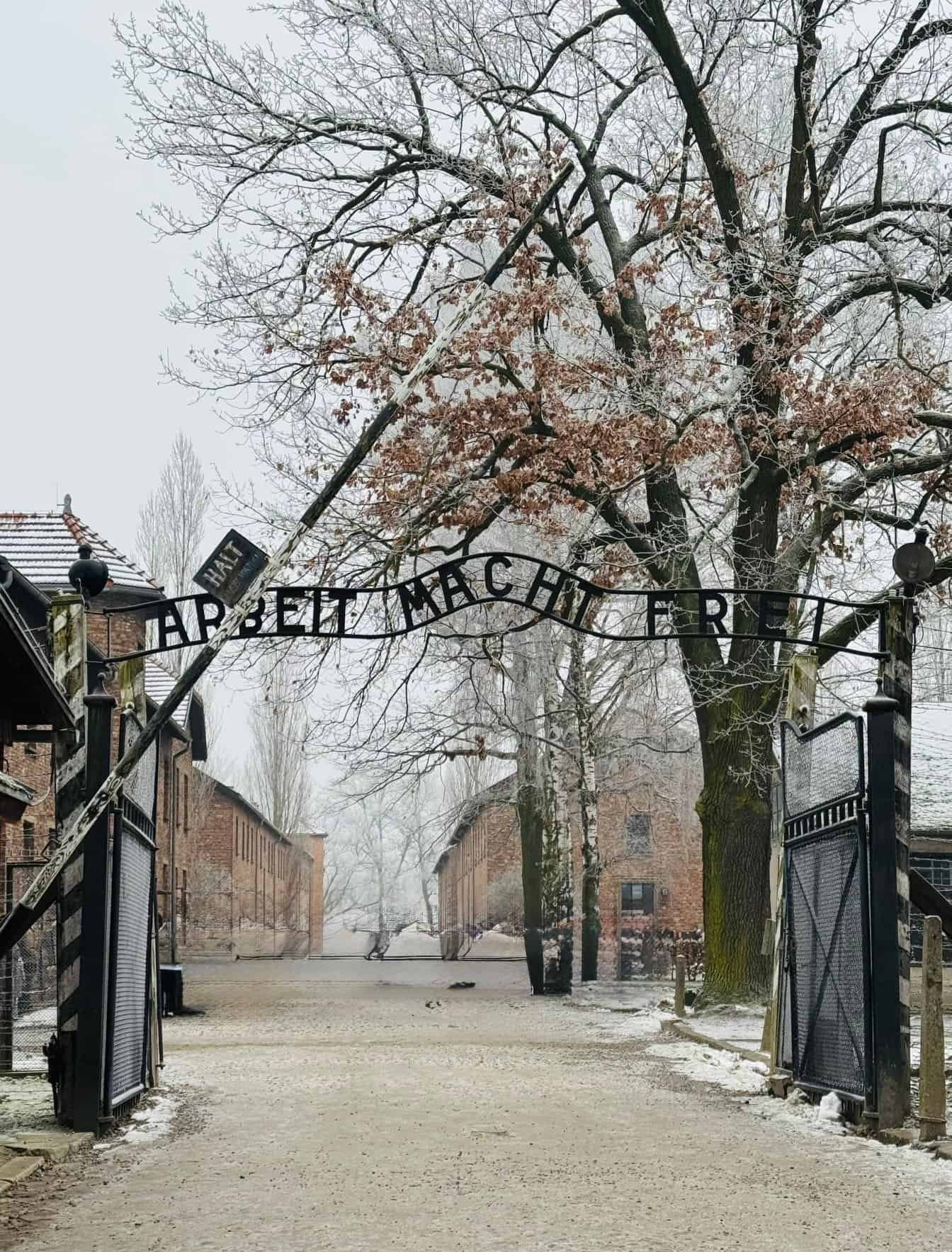
I went first thing in the morning in winter. The fog had not yet lifted, the snow from the night before had not melted yet, and the trees were bare. I remember thinking that this is the closest I would ever get to understanding what they experienced and lived through with no coats and basically scraps for clothing…yet still not close enough at all. Most people go in the summer. They photograph green grass and full trees. What I saw was closer to the truth.
Before I went to Poland last winter, I read The Tattooist of Auschwitz and The Librarian of Auschwitz, thinking it would prepare me for the visit by giving more context. It did not.
We chose a private tour at Auschwitz so the experience could be more intimate. There were six of us. Our guide met us at the entrance and introduced herself.
She told us that two of her uncles had been held here, as part of explaining why she does this work. She had originally taken the job hoping to find out what happened to them. She found information on one of them fairly quickly. The other took years of working there, going through records, before she found his name and learned his fate. She has been giving these tours for more than thirty years.
I am not going to use her name, as hers is just one of the thousands of stories like this that are held in those walls.
We entered through the gate with the iron letters Arbeit Macht Frei…Work sets you free, which was a lie that greeted every one of their prisoners on arrival. I walked under it the same way they were forced to. I do not know what to say about doing that. I have not figured it out yet.
Inside the first camp, Auschwitz I, the brick buildings still stand. The buildings are clean now, restored, but the inside of them holds what was taken. One room is shoes. A wall of them behind glass, thousands and thousands, dark and worn and pressed together. Some are small. Some look like they belonged to children. I had read about the shoes, but that’s not the same as seeing them. The kitchenware, eyeglasses, suitcases, it just goes on and on.
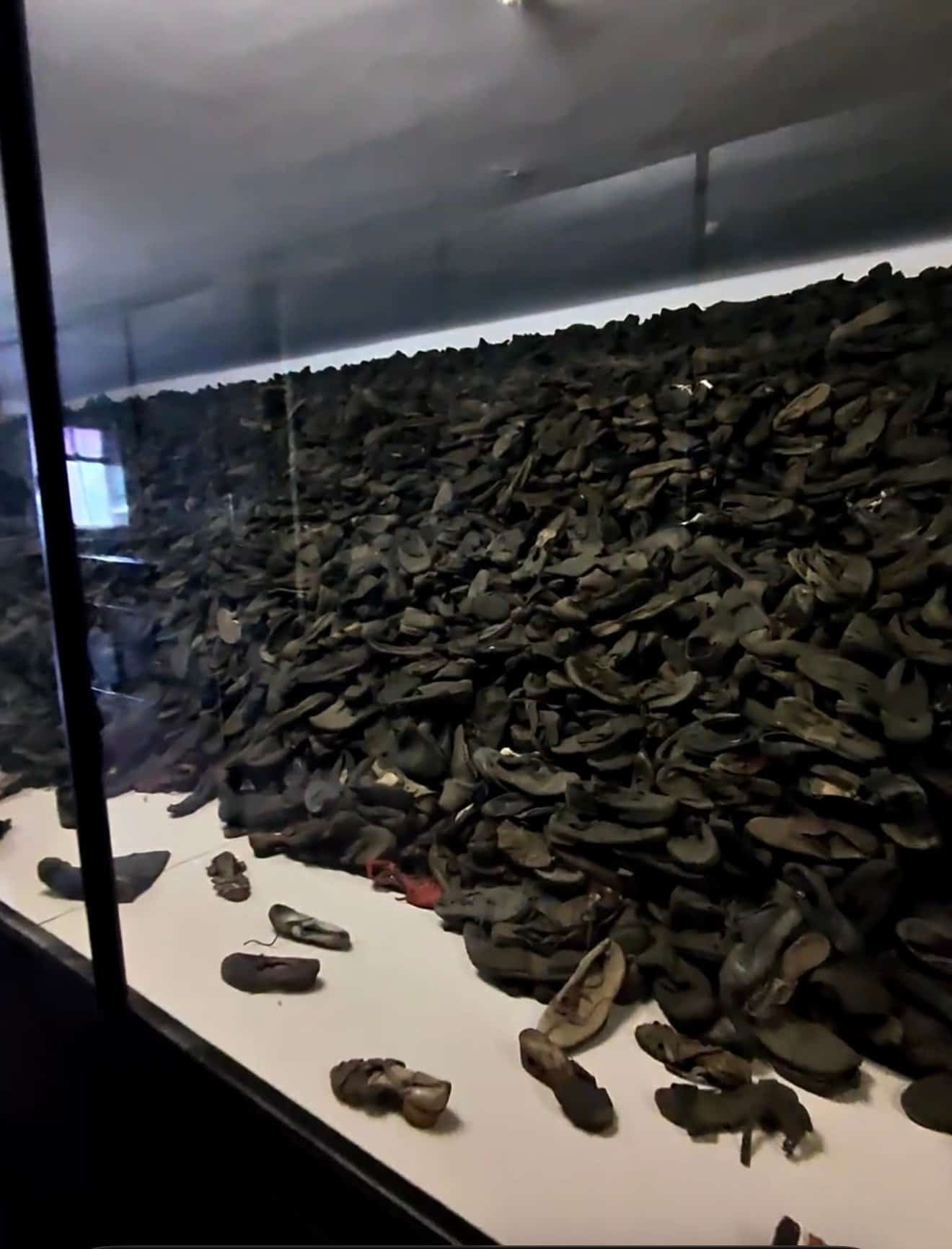
I can’t even begin to describe the feelings experiencing this brought up, and I don’t think I am even going to try.
Our guide then walked us to Block 11, where the corridor of cells inside is narrow and dark. She stopped at one of them, a standing cell, and explained that people were forced into it standing, often four at a time, in the dark, for days. There was no room to sit down, no room to lie down. And if someone died while in there, the body was just left where it was, weight pressed against the others who were still trying to stay alive. The cell is less than one square meter…for perspective, smaller than the closet in any room you have ever stayed in.
She showed us the inside first, and it was here that she told us this is where one of her uncles was held, the one her family had struggled for years to find.
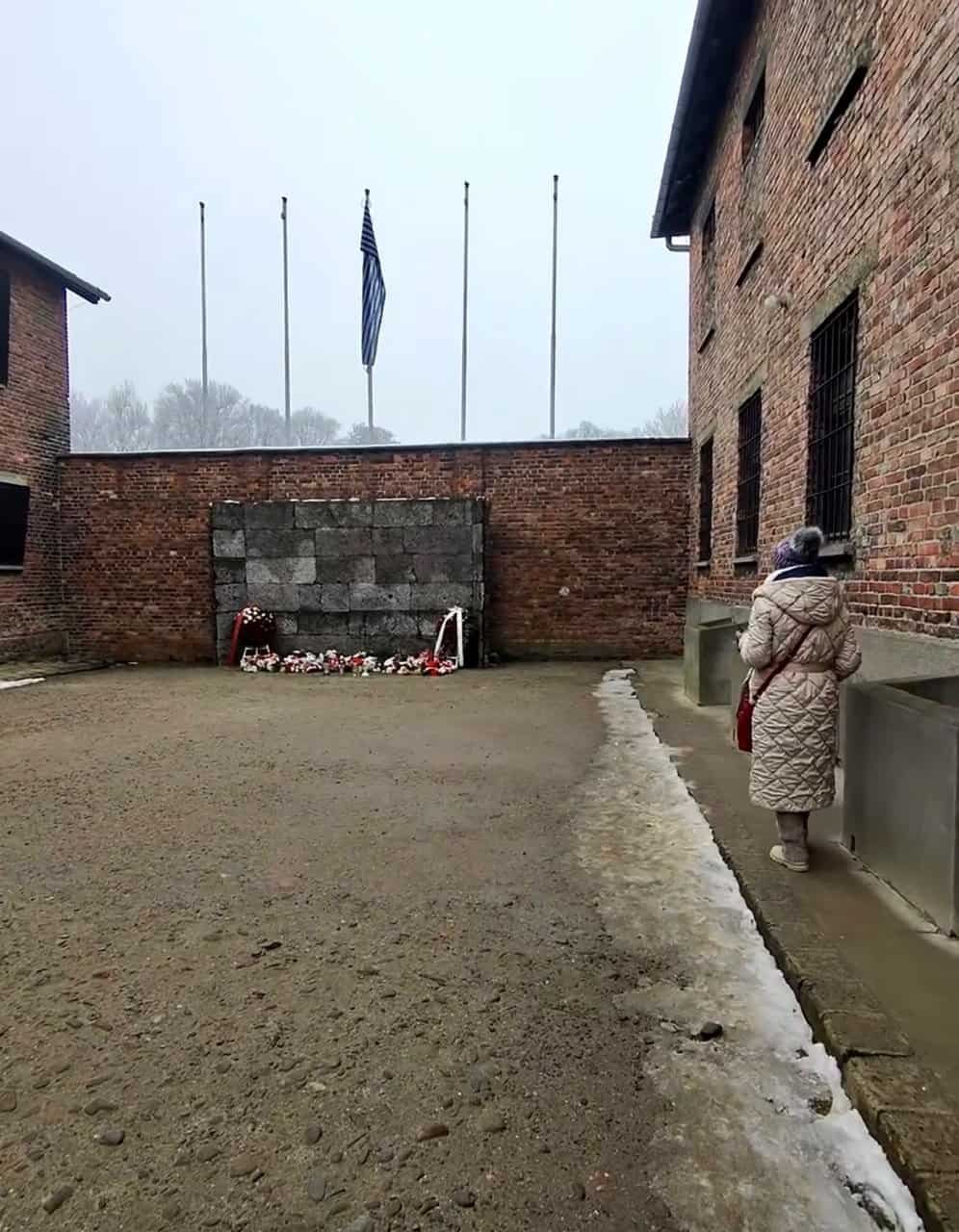
Then she walked us out of the building, into the courtyard between two walls, to the Death Wall, where the executions happened. The wreaths and flowers from recent visitors were still there, leaning against the stone. People had come and left them. She told us what happened at the wall…the way prisoners were brought out one at a time, the way it was done. Her voice was the same even voice she had used for everything else.
Then she stopped at the basement windows of Block 11. The bars were still there, so the prisoners could hear what was happening outside, but a small brick wall had been built in front of the windows so they could not see. She paused in front of one of them, the second closest to the Death Wall, and said this is where my uncle was held.
Then she said, “he could hear a lot of voices of those that were killed here before he was shot here.”
That is what she said. I am writing it the way she said it, because cleaning it up would be wrong.
No one in the group made a sound.
She waited a moment and then continued, because she had to continue. There were more rooms to walk through. She did not cry, she did not lower her voice. She has found a way to say it without breaking, every day for more than thirty years. I do not think that means it does not break her…I think it means she has decided that the telling matters more.
I took a photograph of her standing outside the cell, by the Death Wall. She was not looking at me. I do not know why I took the photograph. I think because I did not want to forget where I was standing when she said it.
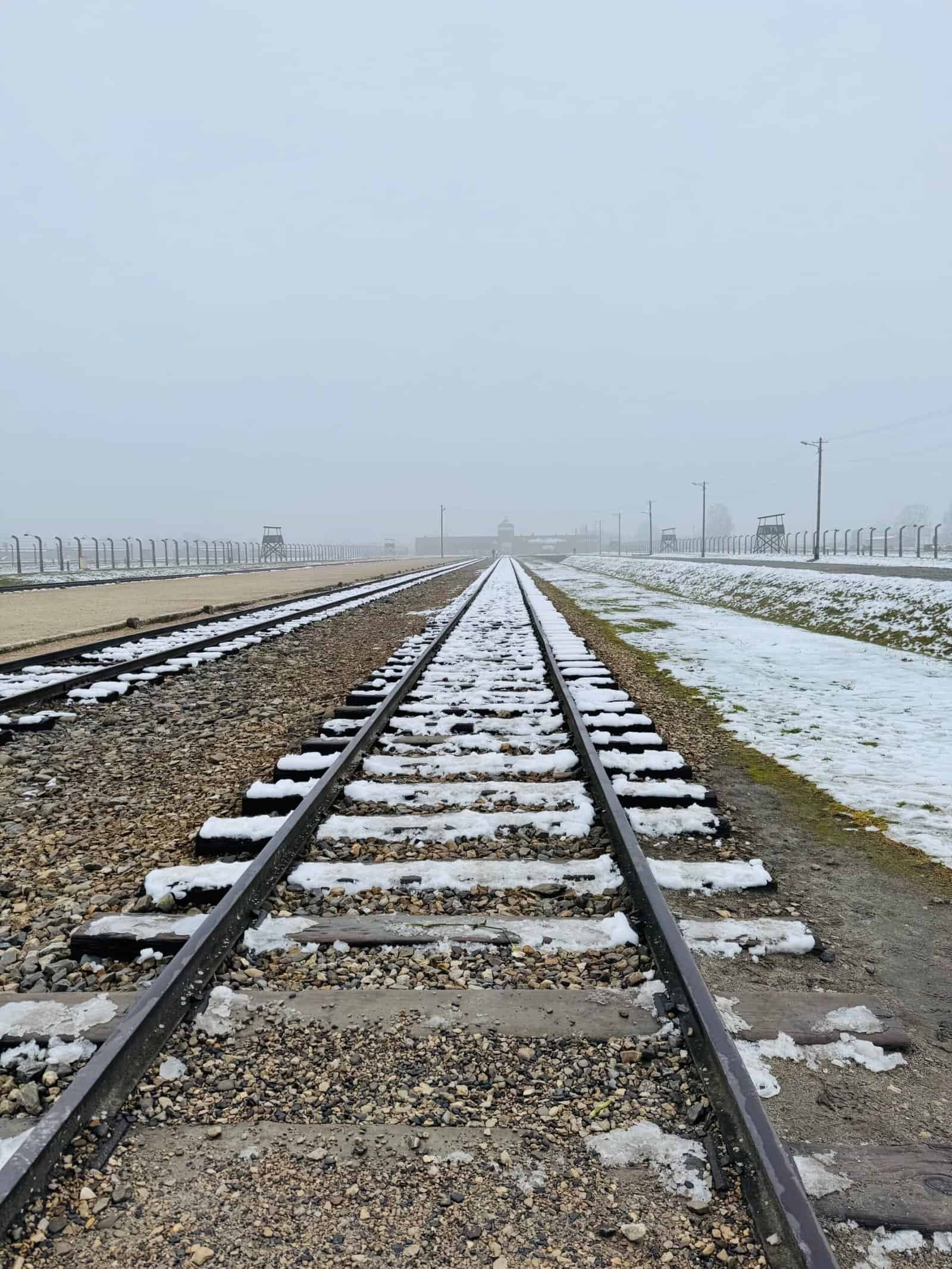
We went on to Birkenau after that…the second camp, the bigger one. The fields stretch on past where you can see them, and the fog had not lifted there either. The tracks run into the gatehouse, a single line in from the world, and there is a single wooden boxcar still sitting on them, the kind of car they used. There is no way to look at it and not understand. The watchtowers stand at intervals all the way to the horizon, and the chimneys from the destroyed crematoria rise out of the snow in the distance.
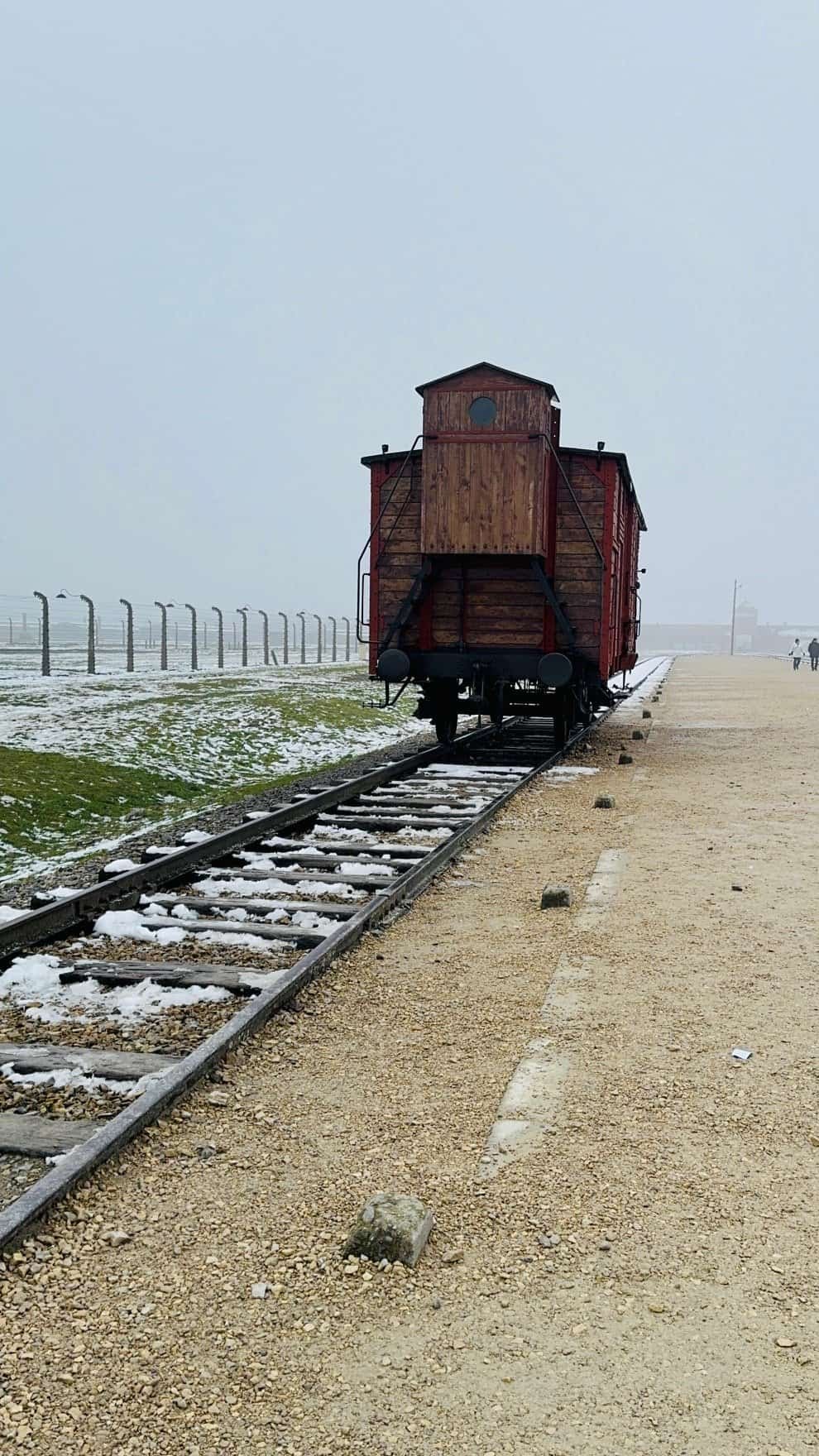
We walked there too. She showed us the foundations of the barracks, the field where the selections happened, the place where the train stopped. She kept going. We kept following.
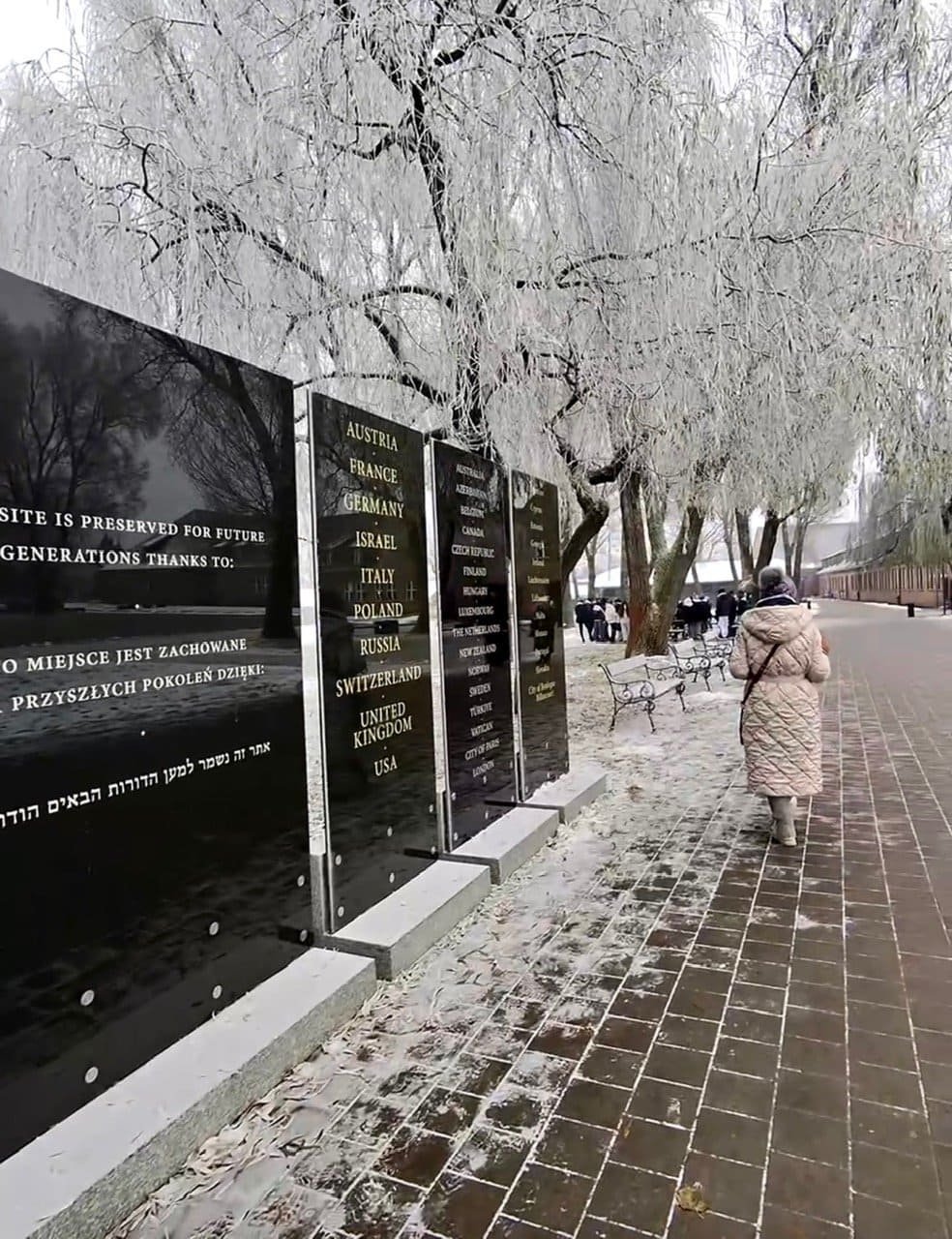
The visit ended where the memorial plaques stand. The countries that helped preserve the site are listed there, and a weeping willow above them was frosted white that morning, the branches drooping over the names. The inscription says the site is preserved for future generations. I walked past it slowly. She had walked ahead by then.
I think the post I am writing is about her, even though I went there to see the place.
The place is what it is…it is preserved, it is open, you can walk through it. The work the memorial does is enormous and patient and quiet. But the place by itself does not teach you. A person teaches you. A person who is left has to stand in a courtyard and tell you about a standing cell smaller than a closet, and the wall where the killing happened a few steps away, and her uncle who heard the voices of the people being killed before they killed him too.
She goes back tomorrow. She will say it again, to another small group of strangers. They will stand the way we stood. Some of them will write something afterward.
I am writing mine now. I am still not sure I know how.
Krakow, where this trip began, is one of the destinations I write about on my hidden gems and off-the-beaten-path travel page.